
Jimmy Davidson founded Silver Loon Roofing in Crosby, Minnesota, in 2026. Before that he spent more than 30 years building custom homes in the Crested Butte area of the Colorado Rockies, mostly framing, interior and exterior trim, and roofing, with plumbing, electrical, painting and drywall work along the way. He lives in Crosby with his four kids, scopes every estimate himself and checks every job.
Hail damage coverage in Minnesota depends on three variables your policy sets and one your roof conditions determines: whether you have ACV or RCV coverage, whether your policy carries a cosmetic exclusion endorsement, whether Minnesota's matching law applies to your claim, and whether the damage is functionally significant enough to exceed the adjuster's replacement threshold. Most standard Minnesota homeowner policies cover hail damage to roofing; the disputes arise over scope, valuation, and what "functional" means.
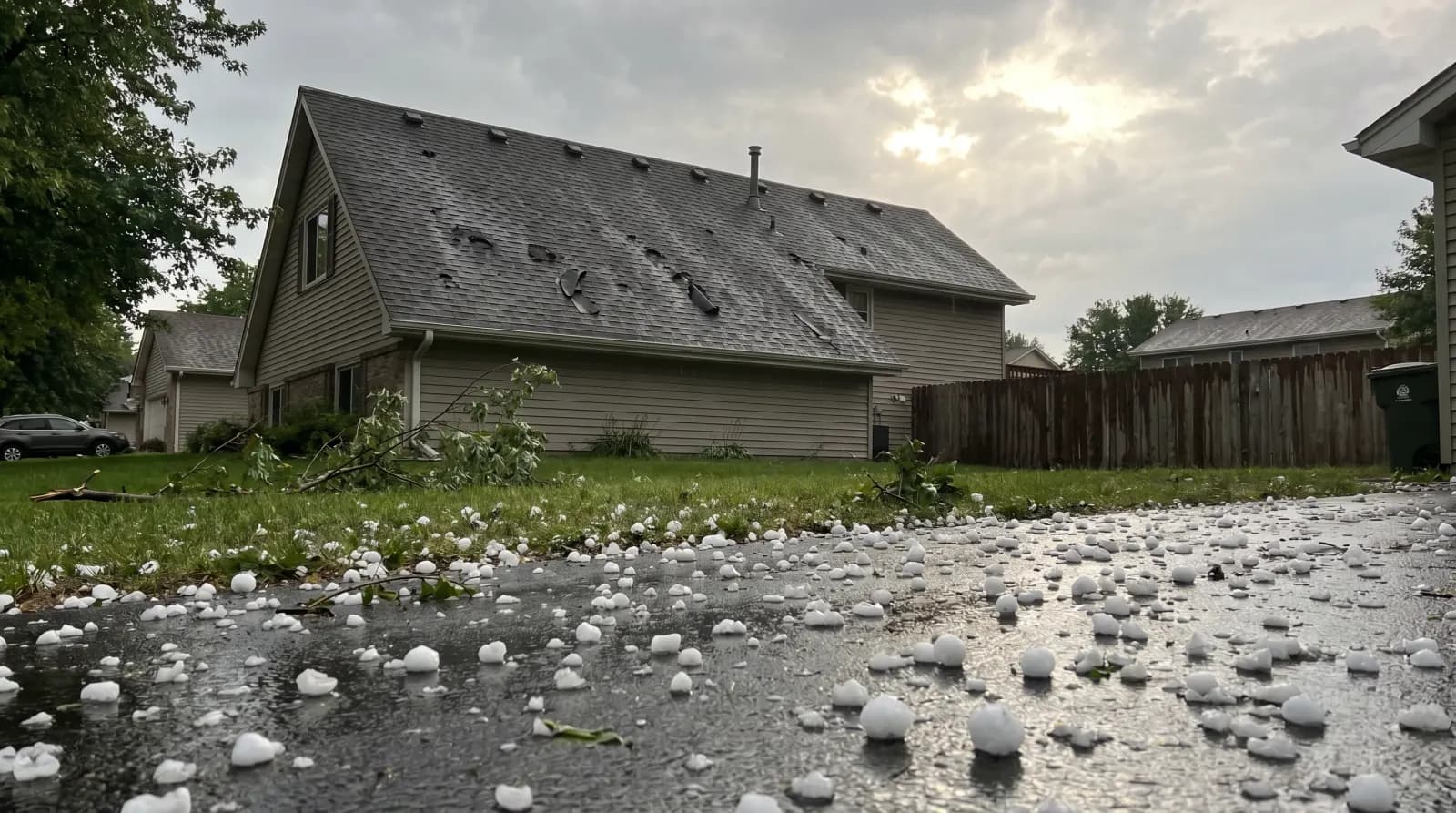
Minnesota sees significant hail most years. Crow Wing, Cass, and Aitkin counties sit inside the hail belt that extends from the Texas panhandle north through the Dakotas and into southern Canada, and the Brainerd Lakes area takes its share of storms most summers. A similar event in 2019 produced a wave of claims across Crow Wing County and the lake communities. If you own a home in Minnesota, you will likely file a hail claim at some point.
Here is how to understand what the claim will and will not cover.
How Hail Damages Asphalt Shingles
Hail damage to asphalt shingles shows up in four ways, and adjusters are specifically trained to identify each:
The Chalk Test
The standard field method for documenting hail impacts on asphalt shingles is the chalk test. An inspector draws a chalk circle (typically 10 inches in diameter, approximating a 1-square-foot test area) around each impact mark. Impacts are counted per circle and then extrapolated to determine the damage density per roofing square (100 sq ft).
Most insurers use an internal threshold — often 8 or more qualifying impacts per 100 sq ft — to determine whether damage is sufficient for full replacement rather than repair. That threshold is not published in your policy; it is an internal claim guideline. A contractor who works insurance claims regularly knows the practical threshold for major insurers in Minnesota.
Bruising
The defining sign of functional hail damage on an asphalt shingle is bruising — a soft spot where the hail impact has fractured the fiberglass or organic mat beneath the granule surface. To identify it, press the shingle surface near the impact mark with a thumb. A bruised shingle compresses noticeably; an unaffected shingle has firm resistance. Bruising indicates mat fracture, which compromises the shingle's ability to resist water infiltration as the roof ages and the granule coat continues to wear.

Bruising is not always visible without close examination and, in the early weeks after a hail event, the impact marks can be subtle. They become more visible over the following months as the granule loss around the impact site expands and the exposed mat begins to oxidize dark.
Granule Displacement
Hail impacts knock granules off the shingle surface at the impact site. Large hail events produce visible granule accumulation in gutters, at downspout outlets, and in window wells — sometimes within hours of the storm. This granule accumulation is useful documentation: photograph it before any rain washes it away.
Granule loss at impact sites is both a cosmetic and functional indicator. Small, well-contained areas of granule loss with no mat fracture may be cosmetic. Widespread granule loss — multiple impacts per square across several slopes — that exposes the asphalt mat is functional damage, because UV exposure accelerates mat oxidation and the shingle's effective service life is now shortened.
Mat Fracture
The most severe hail impacts penetrate through the granule layer and crack or fracture the fiberglass mat itself. This is the clearest functional damage indicator and is typically visible on close inspection as a dark star-shaped crack radiating from the impact center. Mat fracture is unambiguously functional — a fractured mat cannot flex through freeze-thaw cycles without the crack propagating, and it cannot resist water infiltration at the impact site.
ACV vs RCV: The Policy Variable That Matters Most
The single most important variable in your hail claim is whether your policy pays Actual Cash Value (ACV) or Replacement Cost Value (RCV).
ACV policies pay the depreciated value of your roof at the time of loss. A 20-year-old asphalt shingle roof with a 25-year lifespan is at 80% of its life — ACV coverage on a $13,000 replacement scope would pay approximately $2,600 (20% of value remaining), less your deductible. Your out-of-pocket on the same claim is $10,400 plus the deductible.
RCV policies pay the cost to replace the damaged component with like material at current prices, regardless of age. The same $13,000 scope under RCV coverage: the carrier pays $13,000 minus your deductible. Your out-of-pocket is the deductible only.
Most Minnesota homeowner policies written in the past 10 years are RCV policies. Older policies, investment properties, and some carriers who entered the MN market after major hail events have moved toward ACV as a cost-control measure. Check your declarations page under "Loss Settlement" — it will indicate ACV or RCV. If it is not clear, call your agent and ask directly before you need to file.
Cosmetic Exclusion Endorsements
Some Minnesota homeowner policies include a cosmetic exclusion endorsement that specifically excludes coverage for hail damage that is cosmetic — meaning it affects appearance but not the waterproofing function of the roof. Under these endorsements, granule loss, minor surface marking, and discoloration from hail impacts may not be covered unless mat fracture or other functional damage is also present.
Cosmetic exclusions became more common in Minnesota after several consecutive years of large hail claims. They reduce premiums modestly in exchange for shifting cosmetic repair costs to the homeowner. If you bought or renewed your policy in the past 3–5 years without specifically reviewing the endorsements page, check for "Cosmetic Damage Exclusion" or similar language.
Practical implication: if your policy carries a cosmetic exclusion, the adjuster will apply a higher standard when evaluating whether a claim meets the functional damage threshold. Bruising and mat fracture still qualify; surface marking alone may not.
Minnesota Matching Law Considerations
Minnesota does not have a standalone statutory matching requirement for roofing (as of April 2026), but the issue arises in practice under the insurer's obligation to return the property to "like kind and quality" under most standard policy language.
The matching question most often arises in partial replacement scenarios: if the adjuster approves replacement of one slope but not others, and the manufacturer has discontinued the exact shingle product (or the dye lot no longer matches the existing roof), the homeowner has a legitimate argument that partial replacement does not restore "like kind and quality." In these situations, some adjusters will authorize full replacement; others will not, and the dispute goes to the appraisal process.
The practical advice: if you are in a partial replacement scenario and the match is imperfect, document the mismatch clearly in writing before accepting the scope. Your contractor can assist with this documentation. Do not sign a release until the scope is settled.
The Adjuster Inspection: What to Expect
Most insurance adjusters arrive with a ladder, chalk, a measuring tape, and a clipboard. For a standard residential hail claim, the inspection runs 30–90 minutes depending on the complexity of the roof. The adjuster will:
- Walk the perimeter and assess visible damage from the ground
- Access the roof and establish test squares on each slope
- Chalk and count impacts within each test square
- Assess the damage against internal threshold guidelines
- Identify any non-storm-related wear that affects the scope
Having a roofing contractor present during the adjuster inspection is your best tool for ensuring accurate documentation. A contractor who handles insurance claims knows what adjusters are looking for, can point out missed impacts, and can flag discrepancies between the adjuster's scope and a complete replacement estimate in real time. See our full guide to filing a roof insurance claim in Minnesota for the step-by-step process.
What Typically Causes Claim Disputes
Based on claim patterns across the lake country we serve, the most common dispute sources are:
Threshold disagreements. The adjuster counts impacts below the internal threshold and calls it repair; the contractor's count shows replacement-level damage. This is best resolved by requesting a re-inspection with both parties present and documented measurements.
Scope gaps. The adjuster approves the shingle replacement but omits ice and water shield, drip edge, or flashing replacement. These are legitimate supplemental claim items when the existing components are damaged or must be disturbed to complete the approved work.
ACV on an older roof. An ACV policy on a 22-year-old roof that takes replacement-level hail damage can leave the homeowner with a substantial out-of-pocket. This is not a dispute — it is the policy working as written — but many homeowners are surprised by it. Upgrading to RCV coverage at your next renewal, if your carrier offers it, is worth the premium difference.
Cosmetic exclusion applied broadly. Some adjusters apply cosmetic exclusions more broadly than the endorsement language supports. If you believe functional damage (mat fracture, bruising) is being classified as cosmetic, the appraisal provision in your policy is the remedy.
After the Claim: The Repair Process
Once the scope is approved and the first payment issued, the installation process is the same as any roof replacement: tear-off, deck inspection and repair, ice and water shield, underlayment, new shingles, flashing, and cleanup. For most storm-damage replacements on central Minnesota homes, the installation runs 1–2 days.
If you have storm damage questions or want a pre-adjuster inspection, reach out before the claim is opened. Getting accurate documentation early in the process is the most effective thing you can do for a clean claim outcome.
Frequently Asked Questions
What hail size causes functional damage to asphalt shingles?
The industry threshold most often cited is 1 inch (quarter-sized) for standard architectural asphalt shingles — at that size, impacts can produce mat fracture on some shingle products, particularly older or granule-worn material. 1.5-inch (golf-ball) hail causes measurable functional damage on nearly all asphalt products. At 2 inches and above, damage is typically extensive and claim approval for full replacement is routine. Hail below 1 inch may produce granule loss without mat fracture; whether that qualifies depends on the policy and the adjuster's assessment.
How long after a hail storm can I file a claim in Minnesota?
Most Minnesota homeowner policies require "prompt" notice — typically interpreted as 30–60 days from the date of loss, though some policies specify longer windows. The practical issue is that storm documentation (NOAA hail reports, weather data) is most accurate immediately after the event. Waiting 6–12 months to file weakens the documentation and gives the carrier legitimate grounds to question whether the damage occurred in the claimed storm. File promptly.
If my neighbor got a full replacement on the same storm, why did I only get a repair?
Roof-to-roof variation on the same block after a single hail event is real. Factors that affect individual outcomes: the age and existing condition of each roof, the number of qualifying impacts the adjuster counted on each test square, whether each roof had a cosmetic exclusion, and which adjuster handled each claim. If you believe your assessment was under-counted, request a re-inspection with a contractor present.
Can a roofing contractor help me get a larger settlement?
A contractor can legitimately help you get an accurate settlement — one that covers the actual scope of damage — by being present during the inspection, documenting missed impacts, and submitting supplemental claims for scope items the adjuster omitted. What a contractor cannot do is inflate the scope, manufacture damage that does not exist, or waive your deductible. Under Minnesota Statute §325E.66, deductible waivers by contractors are a misdemeanor.
What is the appraisal process and when should I use it?
The appraisal provision in most homeowner policies is a dispute resolution mechanism: each party hires an independent, licensed appraiser; the two appraisers attempt to agree; if they cannot, they jointly select an umpire and two of the three parties must agree on the loss amount. Appraisal costs $500–$2,000 but is appropriate when the disputed dollar amount is significant — typically $3,000 or more. It is not litigation; it is a structured negotiation with a binding outcome.
Have hail damage questions or want a pre-adjuster inspection for your Minnesota home? Reach out at /contact/ — we serve the lake country we call home: Crosby, Brainerd, Nisswa, Crosslake, the Whitefish Chain, and Gull Lake. Free inspection, no obligation.
Jimmy Davidson founded Silver Loon Roofing in Crosby, Minnesota, in 2026. Before that he spent more than 30 years building custom homes in the Crested Butte area of the Colorado Rockies, mostly framing, interior and exterior trim, and roofing, with plumbing, electrical, painting and drywall work along the way. He lives in Crosby with his four kids, scopes every estimate himself and checks every job.
More from Jimmy →