
Jimmy Davidson founded Silver Loon Roofing in Crosby, Minnesota, in 2026. Before that he spent more than 30 years building custom homes in the Crested Butte area of the Colorado Rockies, mostly framing, interior and exterior trim, and roofing, with plumbing, electrical, painting and drywall work along the way. He lives in Crosby with his four kids, scopes every estimate himself and checks every job.
Filing a roof insurance claim in Minnesota takes seven steps, typically 3–6 weeks from the storm date to the carrier releasing final payment. The process is straightforward when you know what adjusters look for and what the law requires of both you and your contractor.
Minnesota sees significant hail activity most years — storms capable of producing golf-ball-sized hail move through the state from late April through September. North-central communities around Brainerd, Nisswa, and the Whitefish Chain also get their share of wind events that lift shingles or push tree debris through roof decks. When your roof takes a hit, storm damage restoration is how you get it restored without spending more than your deductible.
Step 1: Document the Damage Within 24 Hours
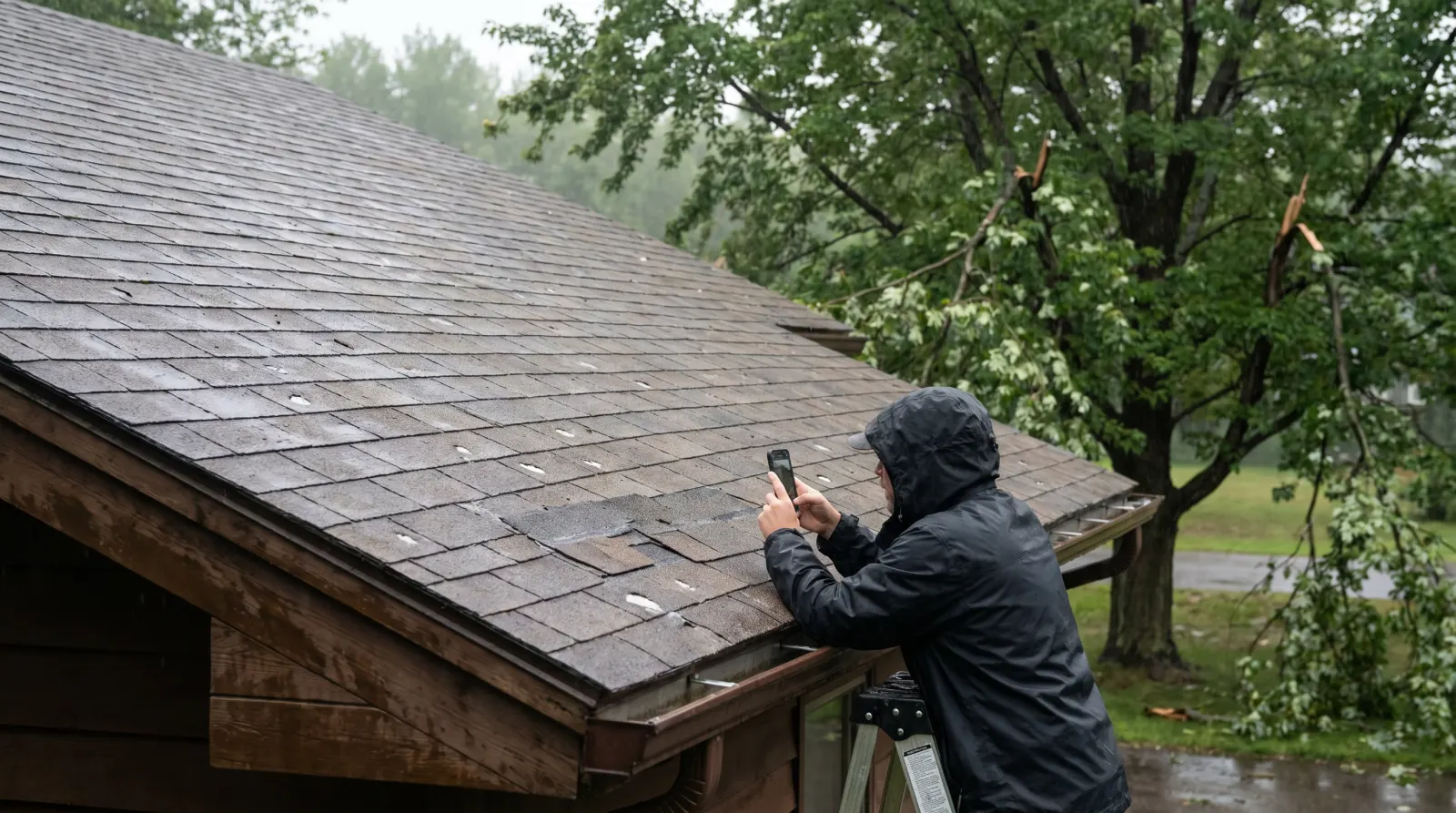
The first thing you do after a storm is photograph. Before any cleanup — before you pick up the branch that landed on the deck, before you call anyone — document what you see.
Date-stamped smartphone photos are admissible for insurance purposes. Photograph from ground level: hail impacts on gutters and downspouts (easier to see and photograph than shingles), damage to wood fencing or vehicles (corroborates hail size), and any visible granule loss in window wells or at downspout outlets.
Do not climb your roof to document. You are not a roofing professional, and falls from residential roofs are the leading cause of fatal home accidents. Document what you can safely see from the ground and from inside the attic (interior water staining, wet insulation).
Pull a storm event record from NOAA's Storm Events Database or ask a roofing contractor — most subscribe to weather data services like CoreLogic or Verisk that can pull exact hail size and storm path data for your address on a specific date. This documentation matters if your carrier disputes whether the storm reached your property.
Step 2: Open the Claim with Your Carrier
Most Minnesota homeowner policies require you to notify your carrier "promptly" after a loss. Read your declarations page — some policies specify 30 days, others 60, and a few have no explicit timeline but require notice before any repairs begin.
Call the claims number on your policy card. Have your policy number and storm date ready. The carrier assigns a claim number; get that in writing (an email confirmation is fine).
Ask two specific questions when you open the claim:
-
Does my policy pay Actual Cash Value (ACV) or Replacement Cost Value (RCV)? ACV pays the depreciated value of your roof at the time of loss. RCV pays the cost to replace it with like materials at current prices. The difference can be several thousand dollars on an older roof.
-
What is my deductible, and is it a percentage or a flat amount? Older Minnesota policies often carry flat deductibles ($500–$2,500). Policies written after 2015 increasingly carry percentage deductibles — 1% or 2% of the dwelling coverage value. On a home insured at $350,000, a 1% deductible means $3,500 out of pocket regardless of the claim amount.
Step 3: Get a Contractor Inspection First

Schedule a licensed roofing contractor to inspect your roof before or alongside the insurance adjuster. This is not aggressive or adversarial — it is how the process is supposed to work.
A contractor experienced with insurance claims knows what damage patterns adjusters are trained to document. Hail bruising on asphalt shingles is subtle — it looks like a soft spot or a dark discoloration where granules have displaced, exposing the mat underneath. Adjusters chalk the bruises to count them; a qualified roofing contractor can point out marginal hits the adjuster might otherwise skip.
At Silver Loon Roofing, we provide pre-adjuster inspections as a standard part of our storm damage service for homeowners in Crosby, Brainerd, Nisswa, Crosslake, the Whitefish Chain, and Gull Lake. No charge for the inspection; no obligation.
Step 4: Meet the Adjuster — and Know the Deductible Law
Be present for the adjuster's inspection. You do not need to be on the roof, but you should walk the perimeter with them and ask questions.
Specific things to ask:
- How many qualifying hail impacts did you find per 10-square-foot test square?
- Is the damage sufficient for full replacement, or are you calling it repair?
- Are you including ice and water shield, drip edge, and flashing in the scope?
Minnesota §325E.66: Deductible Waivers Are Illegal
This is important. Minnesota Statute §325E.66 makes it a misdemeanor for a roofing contractor to waive, absorb, rebate, or otherwise pay a homeowner's insurance deductible as an inducement to hire them. If a contractor says "we'll cover your deductible" or "you don't need to pay your deductible," walk away. That arrangement is insurance fraud, and as the homeowner you can be implicated.
You are responsible for your deductible. Budget for it before the claim. For a typical residential claim with a $1,500 flat deductible and a $13,000 replacement, your out-of-pocket is $1,500.
Step 5: Review and Approve the Scope
The carrier's loss statement will itemize every line: number of roofing squares, tear-off, disposal, underlayment, ice and water shield, drip edge, flashing, ridge cap, and labor. Review this against your contractor's estimate.
Common gaps between adjuster scopes and contractor estimates:
- Ice and water shield — adjusters sometimes allow only eave coverage; your contractor may spec full valley coverage per code
- Drip edge — sometimes omitted or underpriced
- Flashings — chimney, pipe boots, and step flashing are frequently underestimated
- Starter strip — sometimes missing as a separate line item
Your contractor can submit a supplemental claim for legitimate missed items with documentation. Carriers handle supplementals routinely — it is not confrontational, it is part of the process.
Step 6: Schedule the Work and Handle Payments
The carrier's first check (ACV minus deductible) typically arrives 7–14 days after the adjuster's inspection. On RCV policies, you will see two checks: the ACV check upfront and a depreciation release check after work is complete.
Note: if you have a mortgage, the check may be made out to both you and your lender. Your lender will need to endorse it; call them before the check arrives to understand their endorsement process, which can add a week or two.
Work typically does not begin until materials are ordered and the first check clears. For most central Minnesota homes, lead time on GAF Timberline HDZ shingles runs 3–7 days; custom metal or specialty material orders run longer.
Step 7: Pass Final Inspection and Close the Claim
After installation, document the completed work. Your contractor should provide:
- Completion photos (overview and detail shots of valleys, flashings, and ridge)
- Manufacturer's warranty registration confirmation
- A signed completion certificate or invoice marked paid
For RCV policies, submit these to your carrier to trigger the depreciation release. Some carriers send a re-inspector; most accept contractor documentation. The depreciation check typically releases within 10–21 days of submission.
Keep your full claim file — every photo, estimate, correspondence, and receipt — for at least five years.
Frequently Asked Questions
How long does a Minnesota roof insurance claim take from storm to payment?
For a clean hail claim on a single-family home with no disputes, expect 3–6 weeks from opening the claim to the carrier releasing final payment. Complex claims, disputes over scope, or supplemental negotiations can run 8–12 weeks.
What if my adjuster says the damage is below the replacement threshold?
Request a re-inspection in writing, and have your roofing contractor present for it. If the dispute persists, most policies have an appraisal provision — each party selects an independent appraiser, and the two appraisers agree on an umpire to resolve disagreements. This process typically costs $500–$2,000 but is appropriate when the disputed amount is significant.
Can I pick my own roofing contractor for an insurance claim?
Yes. You are not required to use a contractor the insurance company recommends. You can hire any licensed contractor you choose. The carrier pays based on their approved scope and unit pricing — your contractor works within that scope or negotiates supplementals for legitimate additions.
Does filing a roof claim raise my homeowner's insurance premium?
It depends on your carrier and the type of claim. A weather-related claim (hail, wind) typically triggers less premium impact than an "attritional" claim (interior water damage from deferred maintenance). Your agent can give you a specific answer for your policy before you file. If the damage is marginal, it may be worth paying out of pocket to preserve your claim-free history.
Ready to have your roof inspected before your adjuster arrives? Reach out to us at /contact/ — we serve the lake country we call home: Crosby, Brainerd, Nisswa, Crosslake, the Whitefish Chain, and Gull Lake. Inspections are free, and we can typically schedule within a few days of a storm event.
Jimmy Davidson founded Silver Loon Roofing in Crosby, Minnesota, in 2026. Before that he spent more than 30 years building custom homes in the Crested Butte area of the Colorado Rockies, mostly framing, interior and exterior trim, and roofing, with plumbing, electrical, painting and drywall work along the way. He lives in Crosby with his four kids, scopes every estimate himself and checks every job.
More from Jimmy →