
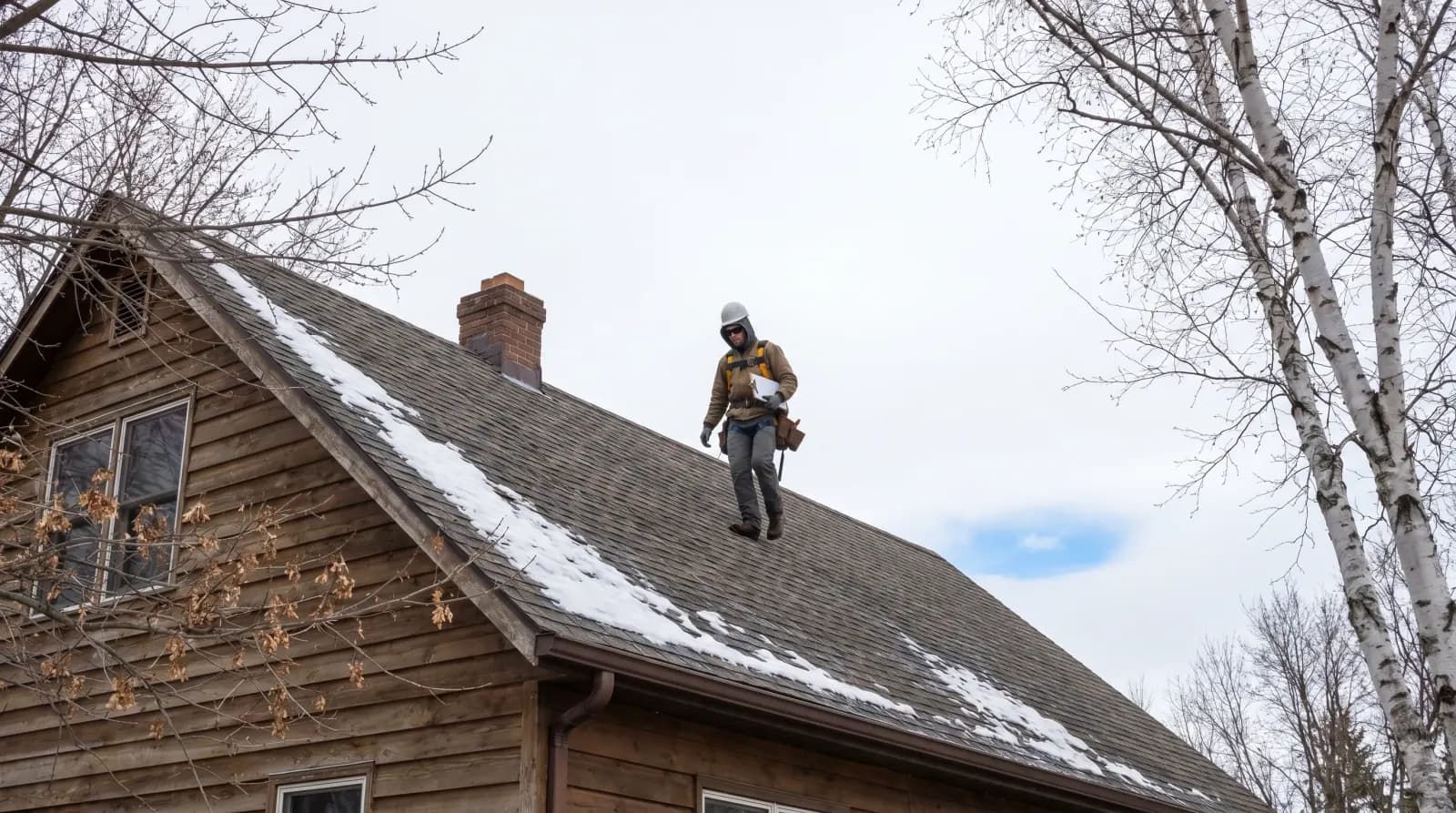
Jimmy Davidson founded Silver Loon Roofing in Crosby, Minnesota, in 2026. Before that he spent more than 30 years building custom homes in the Crested Butte area of the Colorado Rockies, mostly framing, interior and exterior trim, and roofing, with plumbing, electrical, painting and drywall work along the way. He lives in Crosby with his four kids, scopes every estimate himself and checks every job.
A Minnesota roof goes through more stress between November and March than most climates see in two or three years — freeze-thaw cycles that cross 32°F 60–80 times per season, ice dam loads at the eaves, heavy wet snow in March, and wind events that work under brittle cold-weather shingles. April is the right time to assess what winter left behind, before the next hail season starts in late May.
This checklist covers what to look for from the ground, from the gutters, and from inside the attic. Most of it you can do without getting on the roof.
Ground-Level Inspection (Items 1–6)
1. Shingles Missing or Displaced
Walk the full perimeter of the house on a clear day. Look at each slope from multiple angles. Missing shingles — particularly on high-exposure corners or ridge areas — are the most obvious winter wind damage indicator. Also look for shingles that appear lifted at the tabs (not lying flat against the course below) — this indicates the self-seal strip failed during cold weather and the shingle is no longer bonded.
Note: shingles on north-facing slopes sometimes retain patches of ice or debris into April that obscure assessment. Wait for full melt before concluding a north slope is clean.
2. Ridge Cap Condition
The ridge cap — the overlapping shingles that seal the peak of the roof — takes direct wind exposure. Look for lifted ridge cap pieces, any sections that appear cracked or separated, and the overall straightness of the ridge line. A wavy ridge line can indicate framing movement (uncommon but worth noting) or significant shingle displacement.
3. Valley and Flashing Areas
Valleys — the V-shaped channels where two roof planes meet — are the highest-traffic water zones on the roof. Look for any metallic flashing that appears lifted, buckled, or separated from the shingles at the edges. Also check the vertical flashing where the roof meets a dormer or chimney wall — these step-flashing details are common failure points after a winter of thermal movement.
4. Fascia and Soffit Condition
Ice dams damage more than just shingles. The fascia board (the vertical board at the eave edge that the gutters attach to) and the soffit (the horizontal surface underneath the eave overhang) often show water staining, paint failure, or soft spots from ice-dam water that worked past the ice and water shield. Run a hand along the fascia after the snow is gone — soft, spongy wood indicates water infiltration.
5. Gutters and Downspouts
Inspect the gutters for:
- Sagging sections — heavy ice loads pull gutters away from the fascia; the hanger spacing or the fascia itself may be compromised
- Gutter separation at seams — thermal expansion and ice can separate sectional gutters at the connectors
- Granule accumulation — a heavy granule deposit at the downspout outlet after the first good rain indicates significant shingle wear and is worth noting as a baseline for future comparison
- Downspout disconnection — downspouts sometimes separate at the elbow during freeze-thaw movement

6. Ground-Level Debris and Evidence
After the snow melts: check for shingle debris or pieces of flashing in the yard, especially downwind of the house. Any significant amount of shingle granules on the driveway, deck, or window wells that is not explained by a heavy spring rain washing accumulated material through the downspouts indicates recent shingle damage.
Attic Inspection (Items 7–10)
The attic is where winter damage reveals itself before it shows up on the exterior. Do this inspection on a dry day with a flashlight.
7. Daylight Through the Deck
Enter the attic and turn off your flashlight. Let your eyes adjust. Any points of light visible through the roof deck indicate a penetration — a nail miss, a crack in the decking, or a gap at a fastener. Note the location (count rafters from the end wall) and the size. Small nail misses are minor; visible light through a larger area warrants a call.
8. Water Staining on Rafters and Decking
Look for dark staining on the underside of the roof deck and on rafter faces. Fresh staining — damp wood, wet insulation below — is an active leak. Older grey staining that is dry may indicate a resolved leak (perhaps the ice dam that caused it has melted) or a sealed penetration. Either way, note it.
The pattern of staining can tell you the source: staining directly below a plumbing pipe penetration or a valley suggests the source. Staining that follows a rafter from the peak downward suggests a wind-driven rain or ice dam event that infiltrated at the ridge or upper slope.
9. Insulation Condition
Wet or compressed insulation in the attic floor is a sign that ice dam water or condensation reached the attic. Wet fiberglass insulation loses its R-value immediately; wet cellulose can compact and grow mold. Check the perimeter of the attic floor — the area closest to the eave — first, as this is the ice dam infiltration zone.
While you are checking insulation, note whether the depth appears consistent throughout. Many Minnesota attics, particularly in lake cabins and pre-1990 homes, have R-values well below the recommended R-49 to R-60 for MN climate zones. Inadequate insulation is the primary driver of ice dam formation. See our ice dam prevention guide for more on the insulation-ventilation relationship.
10. Soffit Vent Blockage
Check the soffit baffles — the channels that prevent attic insulation from covering the soffit vents. In many attics, blown insulation gradually migrates toward the eaves over time and can partially block the soffit vents even with baffles in place. Blocked soffit vents reduce airflow through the attic, which elevates attic temperature in winter and contributes to ice dam formation.
Mechanical and Detail Items (Items 11–13)
11. Pipe Boots and Penetration Flashings
Every plumbing vent pipe that exits through the roof has a rubber pipe boot around it. These boots are typically black EPDM rubber and have a service life of 10–15 years. Cold temperatures accelerate EPDM brittleness, and the repeated freeze-thaw cycling of a Minnesota winter can crack older boots.
From the ground or with binoculars, look for pipe boots that appear cracked, collapsed, or separating from the shingle field around them. A cracked pipe boot is an inexpensive repair that causes expensive damage if left unaddressed.
12. Chimney Flashing and Crown
If you have a masonry chimney, inspect the flashing where it meets the roof (the step flashing on the sides and the counter-flashing at the back) and the crown at the top. Minnesota freeze-thaw cycles are hard on masonry: the mortar in chimney crowns cracks, water infiltrates, and the expansion of freezing water enlarges the crack each cycle. A chimney with visible crown cracking or missing mortar is a water infiltration risk. This is not a roofing repair — it is a masonry repair — but it is worth noting during the spring inspection.
13. Moss or Lichen on North Slopes
North-facing slopes in Minnesota stay damp longer in spring and never get the UV exposure that south slopes get. Moss and lichen establish more easily on north slopes, particularly in shaded areas near tree canopies. A light lichen presence is cosmetic; significant moss growth holds moisture against the shingle surface and accelerates granule loss.
Do not pressure-wash moss from shingles — the mechanical force dislodges granules. A zinc or copper strip installed at the ridge allows rain to carry a biocide slowly down the slope. Chemical treatments applied by a contractor are effective and do not damage the shingles.
When to Call a Pro
A ground-level and attic inspection gives you most of the information you need to assess your roof's condition. Call a licensed roofing contractor when:
- You find active water staining in the attic (potential ongoing leak)
- You see significant missing or displaced shingles
- You observe visible damage to flashings or pipe boots
- Your roof is 15+ years old and you want a full condition assessment with lifespan projection
- You suspect hail damage from a recent storm event and want a pre-adjuster inspection
Our roof replacement, roof repair, and storm damage service pages explain what each type of inspection involves. If you are in Crosby, Brainerd, Nisswa, Crosslake, the Whitefish Chain, or Gull Lake, reach out at /contact/ for a no-obligation inspection. Spring scheduling fills up quickly — the week after the final snowmelt in April is our busiest inspection period.
Frequently Asked Questions
How often should a Minnesota homeowner inspect their roof?
Once per year — spring is the most logical timing because it catches everything winter left behind. If you had a significant hail or wind event during the year, a post-event inspection adds a second pass. Homeowners with ice dam history should also do a mid-winter attic check in January or February to catch active infiltration early.
I found water staining in the attic but it is dry now. Is that a problem?
Dry historical staining may indicate a resolved issue — an ice dam that caused a one-season leak before melting, or a pipe boot that was repaired. It is still worth having a contractor assess the source, because staining that looks resolved from below does not always mean the penetration is sealed above. Document the location and have it checked before the next winter.
My gutters are full of granules every spring. Is that normal?
Some granule loss is normal, particularly in the first few years after installation (new shingles shed loose surface granules from the manufacturing process). Heavy granule accumulation — a cup or more per downspout outlet after a typical rain — on a roof that has been in place for 10+ years is a wear indicator worth noting. It does not automatically mean replacement is needed, but it is a data point in the replace-vs-repair calculus.
How do I know if a soft spot in the attic is a structural concern?
A small soft spot under a penetration — isolated to a few square feet around a pipe or valley — is typically a localized water damage issue, not a structural concern. A soft spot that extends along a rafter, that shows visible mold or rot on the framing itself, or that has caused noticeable sag in the roof plane is more significant and warrants a contractor assessment before the next winter.
What is the risk of moss on my north slope?
Significant moss growth holds moisture against the shingle surface longer than normal weathering, which accelerates granule loss and can lift shingle tabs over time. On an older roof approaching the end of its service life, moss growth is an additional stress to a system already showing wear. On a newer roof, treating the moss early prevents it from establishing at a level where it causes damage.
Spring inspection done and you found something worth a second look? Reach out at /contact/ — we cover the lake country we call home: Crosby, Brainerd, Nisswa, Crosslake, the Whitefish Chain, and Gull Lake. Spring scheduling is tight; early April appointments fill first. Our estimator tool can give you a preliminary cost range for any work that the inspection surfaces.
Jimmy Davidson founded Silver Loon Roofing in Crosby, Minnesota, in 2026. Before that he spent more than 30 years building custom homes in the Crested Butte area of the Colorado Rockies, mostly framing, interior and exterior trim, and roofing, with plumbing, electrical, painting and drywall work along the way. He lives in Crosby with his four kids, scopes every estimate himself and checks every job.
More from Jimmy →